SECOND PART
After months of preparation, the moment finally arrives to demonstrate that the Keller-Bühlmann system works in a real open-ocean dive. On December 1st, 1962, after the entire team has arrived in California, Keller and his chosen buddy for the mission, Small, perform a test dive. They exit the diving bell one at a time at a depth of 100 meters and resurface after a total of 126 minutes of decompression following 60 minutes of bottom time. Once again, neither diver shows any symptoms of decompression sickness.
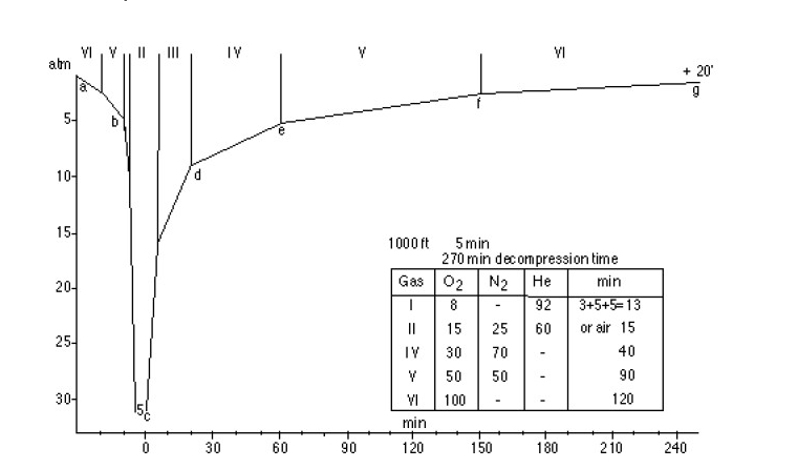
Compression and decompression profiles and gases used
for a dive to 300 meters (1,000 feet) with 5 minutes of bottom time
And so, we come to December 3rd, the day of the official dive. First of all, several aspects must be taken into account, as they will be fundamental and have a significant impact on future events. As a first observation, it should be noted that both divers were wearing constant-volume dry suits made by La Spirotechnique, very different from the ones we use today.
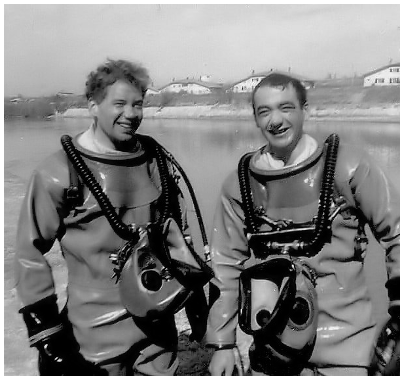
Constant-volume dry suit by La Spirotechnique
In fact, it included a full-face mask and a regulator, both integrated into a watertight hood connected to the neck of the suit. Exhalation did not occur outward but inside the suit, allowing the diver to adjust their buoyancy at will. Valves positioned on the head and feet prevented possible overpressure, thus maintaining a constant volume at any depth. Lastly, the mask had an openable visor to allow easy breathing at the surface.
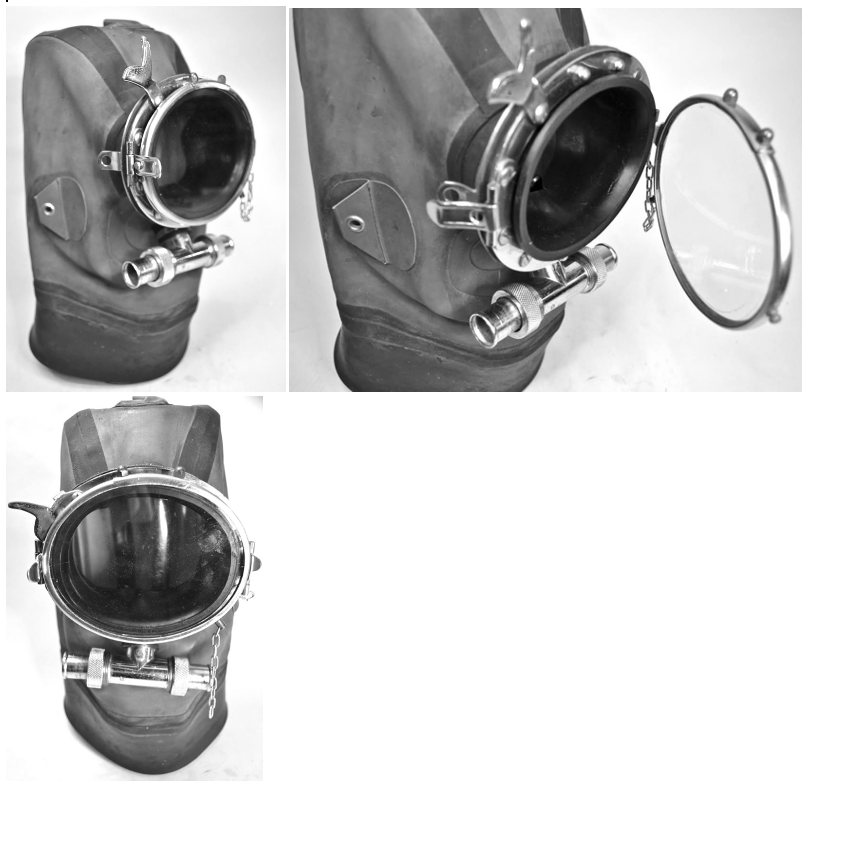
Detail of the hood of the La Spirotechnique dry sui
The second point to note is that, for economic reasons, the diving bell was filled with ordinary air rather than a helium-containing gas mixture. As a result, although Keller and Small were dry inside the Atlantis, they had to keep the faceplate of their masks closed throughout the dive, breathing various gas mixtures from the cylinders attached to the bell. That day, the dive was started and aborted twice due to successive adverse weather conditions. On the third attempt, with Keller in constant contact via intercom with Bühlmann, who was on the surface directing the pressurization of the bell and the gas switches, the planned depth of 305 meters was reached in 16 minutes.
Up to a depth of 138 meters, the divers breathed a nitrogen-rich mixture, then switched to a mix composed of 92% helium and 8% oxygen.
As during the dive conducted in the simulator in Zurich, Keller detached from the onboard gas supply and exited the bell, breathing from the tanks on his back. What happened next remains somewhat unclear. Some sources claim that Keller stayed outside the bell at the bottom for about two minutes, attempting to plant the flags of the United States and Switzerland. However, a U.S. Navy officer who was monitoring the entire operation from the surface via one of the two external cameras later told the press that he only saw someone on the ladder dropping the flags, and that the excursion lasted no more than thirty seconds.
In any case, when Keller returned to the dry environment of the bell and reconnected to the onboard deep-mix gas supply, he immediately realized that the reserve gas in the internal circuit cylinders was nearly depleted. Realizing that it was no longer possible to keep breathing, he carried out a desperate manoeuvre.
He hurriedly closed the lower hatch of the diving bell, unfortunately failing to notice that the tip of one of his fins had become stuck in it, preventing a proper seal. He opened several air and gas mixture valves and lifted the faceplate of the mask on his constant-volume suit, but immediately began to lose consciousness. Let us remember that the bell, due to mere financial constraints, had been pressurized with air instead of a helium-oxygen mixture, and switching suddenly from a light gas mixture like helium and oxygen to a much denser gas like air at a depth of 300 meters inevitably causes severe side effects.
In contrast, Small, for reasons that were never clarified, did not perform the same manoeuvre.
Meanwhile, on the surface aboard the Eureka, Dr. Bühlmann and Mr. Niggli, the chief bell operations officer, saw what was happening on the closed-circuit video feed, realized the drama unfolding, and immediately ordered the bell to be brought up to a depth of 62 meters with a continuous ascent lasting 17 minutes, as planned.
Once they reached the designated depth, it became clear that the Atlantis was rapidly depressurizing due to the hatch not being fully sealed. At that point, Keller, who had fully regained his composure, first opened the faceplate of Small’s mask and, after being informed by the surface control centre that the bell was not completely sealed, attempted to properly shut the hatch so the Atlantis could be safely lifted onto the ship’s deck.
He was unsuccessful, so two support divers, Dick Anderson and Christopher Whittaker, a friend of Small, entered the water twice and swam down to the bell, which was hovering at -60 meters, to assess the problem.
Eventually, they discovered the tip of the fin jammed in the hatch. Anderson broke it off and removed it, and the leak immediately stopped. Unfortunately, Whittaker, who had already appeared visibly exhausted after the first dive, never resurfaced, and his body was never recovered.
When the diving bell was finally lifted onto the ship's deck, the internal pressure was equivalent to a depth of 50 meters. Both Keller and Small were already breathing the gas mixture required at that stage of decompression: 50% oxygen and 50% nitrogen. Later, upon reaching 15 meters, following protocol, they would switch to 100% oxygen until the end of the dive.
At that point, ninety minutes had passed since Keller had opened Small’s mask, and at first glance everything seemed to indicate that Small had recovered fairly well, he was able to communicate normally. But the situation was not quite as it seemed. In fact, Small reported feeling cold, and although he experienced no pain, he was too weak to stand. Moreover, while he retained the ability to speak, see, and hear, he could no longer feel his legs.
As decompression inside the bell continued, he quietly crouched down, as if he had fallen asleep. Meanwhile, with the Eureka rushing at full speed toward the Long Beach naval facility, where the divers could be assisted and recompressed in a fully equipped chamber, decompression was extended from the initially planned 270 minutes to 410 minutes, in order to keep the two divers under hyperbaric conditions until the ship reached port.
Unfortunately, at some point Keller realized that Small was cold and pale, he was no longer breathing. Keller immediately attempted to resuscitate him, but without success.
When the ship finally docked, the bell, still sealed with both divers inside, was immediately lowered onto the quay. Once the pressure inside was brought back to surface level and the hatch was opened, Keller emerged in relatively good condition, showing no signs of decompression sickness. But the same fate did not await Small, who was tragically declared dead.
Later, although Keller always maintained that the cause of his buddy’s death lay elsewhere, perhaps a heart attack or a panic attack that Small might have suffered upon reaching the 305-meter mark, the Los Angeles County coroner identified the cause of death as decompression sickness. Indeed, examinations revealed that Small’s tissues and organs contained excessive amounts of gas bubbles.
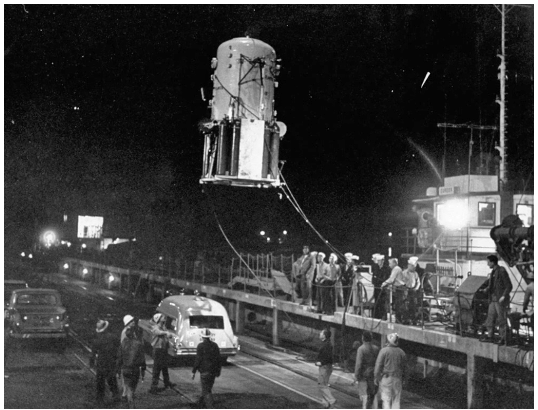
The Atlantis diving bell is lifted after Keller and journalist Peter Small descended to 305 meters
in the Pacific Ocean in December 1962
Following the incident, the media further muddied the waters. In particular, the American magazine Newsweek reported on a document claiming that Peter Small had shown several signs of DCS (decompression sickness) before the fatal dive to 305 meters. It was even said that several members of the U.S. Navy had tried to persuade Keller to replace Small and to carry out a series of acclimatization dives before attempting the record-breaking descent. Despite these suggestions, Keller had shown himself to be firmly determined to proceed as planned, without substitutions and without conducting further gradual-depth tests. The report also allegedly attributed his decision to the pressure caused by the crowd of journalists and spectators who had come to witness the historic dive. This was compounded by time and financial constraints, as well as uncertainty about future availability of the complex equipment, all of which added to the already intense stress, effectively forcing the team to proceed with the experimental dive as scheduled. However, considering that after the fatal dive a variety of inaccurate and incomplete information circulated, and that the reports themselves may have been unreliable, the matter quickly faded into journalistic oblivion. In academic circles, it wasn't so easy.
Regardless of the reports and independent of the actual causes behind the disastrous dive, a failure of this magnitude raised concern among researchers, not only that it might lead to a sharp decline of interest in Keller and Bühlmann’s so-called sensational methods, but that it could significantly set back research in the emerging field of saturation diving. In fact, following the tragic double accident and the ensuing storm of controversy, Keller and Bühlmann increasingly retreated into secrecy, seeking to protect the confidentiality of their methods and “miraculous gases.” Then, in 1963, in order to fulfil part of the contract with the U.S. Navy, Professor Bühlmann submitted a detailed report to Navy Captain Robert Workman, providing full information on the breathing gas mixtures and dive profiles. Two years later, for the benefit of their peers, Bühlmann and Keller co-authored an article published in the Journal of Applied Physiology, titled “Deep Diving and Short Decompression by Breathing Mixed Gases.” At last, all the fanciful speculation came to an end, and the academic world was thoroughly satisfied, and silenced.
In reality, despite the incidents at Catalina, which raised immense doubts in the minds of many, that disastrous day would go on to rewrite the history of diving. Indeed, it wasn’t long before the leadership of the Italian maritime engineering company Micoperi presented Shell International Petroleum with a viewpoint that diverged from the prevailing opinion of failure. Their argument was that Keller and Bühlmann had proven the feasibility of reaching previously unimaginable depths, and surviving. They therefore proposed funding further research into deep diving, anticipating future profits. The suggestion worked so well that, already in 1963, the two were invited to sign a collaboration agreement to continue their experiments in deep-sea diving.
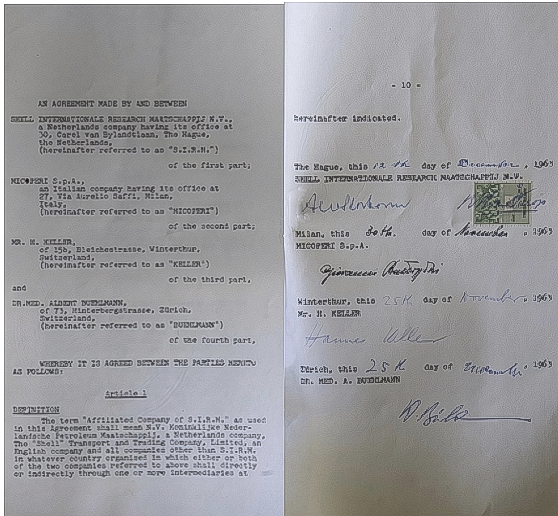
The Collaboration Contract
To this end, a modern and large hyperbaric simulation facility was installed at the University Hospital in the city of Zurich, aimed at developing saturation diving down to depths of 700 meters.
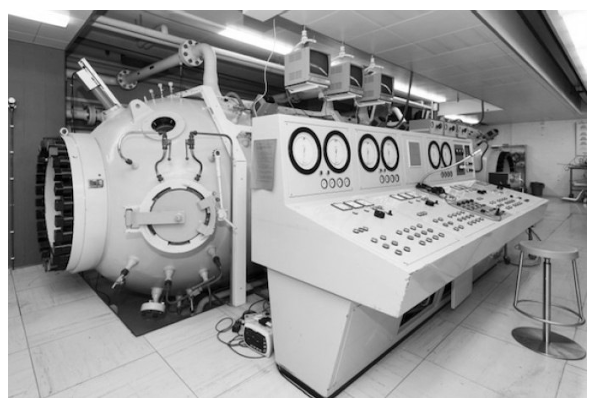
The simulator at the University Hospital of Zurich
At the beginning, all technical implementation responsibilities were entrusted to Keller himself. However, since the research being conducted at the hyperbaric center after 1964 no longer aligned with his vision, Keller was replaced and left the group. All the more so as Bühlmann was no longer interested in spectacular records, but increasingly focused on developing new, more reliable decompression procedures for professional divers working at great depths. The Keller-Bühlmann era had come to an end, and the professor, now free from old constraints, could begin the new challenge of saturation diving.
From the very start of this phase, and in light of the painful experience in California, it became essential for Bühlmann to clearly separate laboratory research activities from the practical application of results in real-world operational conditions.
Work at the simulator resumed with a series of saturation dives to 30 meters. These seemingly odd tests were actually used to determine new half-time values for specific tissues, which were thought to be longer than those used for air.
Between 1965 and 1966, without neglecting saturation dives, the main focus shifted to professional diving operations where the diver was to be brought directly back to the support vessel to begin decompression inside a hyperbaric chamber. For this purpose, more than one hundred tests were conducted, reaching depths of up to 220 meters.
At the same time, Shell wasted no time and launched a field-testing program in the Mediterranean together with the maritime engineering company. For this, a new large, combined diving bell, the Capshell, was specially built. Between August and September 1966, professional divers from Micoperi and Swiss recreational divers performed a series of dives using both on-board decompression and saturation techniques.
The series concluded with a final saturation dive to 220 meters without any incident, confirming the reliability of the Swiss research group’s work. It was the first time that long-duration deep diving had been successfully demonstrated under real conditions.
Following these encouraging results, Shell and Micoperi formed a joint venture, Sub Sea Oil Services, a company that would make history in the field of commercial diving. Between 1965 and 1981, the year in which the Shell contract expired, Bühlmann and his team conducted around 40 experimental dives beyond 200 meters, including a record-breaking dive in 1981 to 500 meters and an excursion to 575 meters.
But despite the tangible and real successes of Bühlmann and his staff, doubts began to emerge within the commercial diving industry regarding the practical application of this immense body of work.
Indeed, shortly after that record-setting dive, it became clear that human diving had reached its limits. And although greater depths would later be reached in research laboratories such as Comex and Duke University, experiments like Bühlmann’s would never be applied in actual work operations. In the end, deep professional diving proved too costly and too risky. Consequently, with profitability close to zero, it was gradually replaced by the increasingly reliable ROV (Remotely Operated Vehicle) technology.
This new offshore revolution led Shell to conclude that investing in deep diving research was no longer worthwhile. Thus, after nearly twenty years of collaboration, Shell chose not to renew its contract with Bühlmann and his team.
With the end of his partnership with the oil company that had supported most of his work, the professor did not stop. From mid-1981 to the end of 1985, he carried out several more tests at his laboratory in Zurich. His goal was to develop a data foundation for new decompression tables that would include repetitive dives, usable for altitudes ranging from sea level up to 4500 meters.
This gave birth to the ZHL algorithm, a tool cherished by recreational divers to this day.
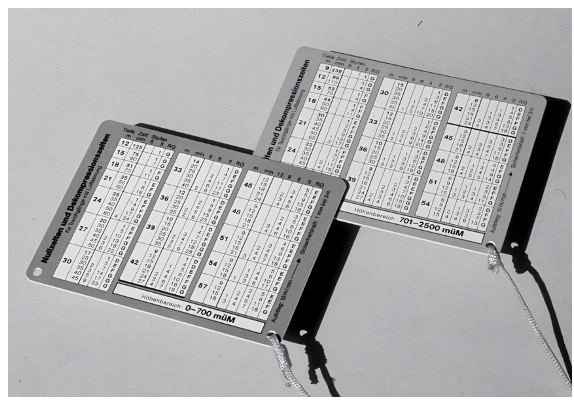
Bühlmann’s new tables
In this phase, Bühlmann addressed for the first time the topic of dive computers for decompression. The Deco-Brain II, developed by Divetronics, was the first to use his decompression model, albeit in a modified form.
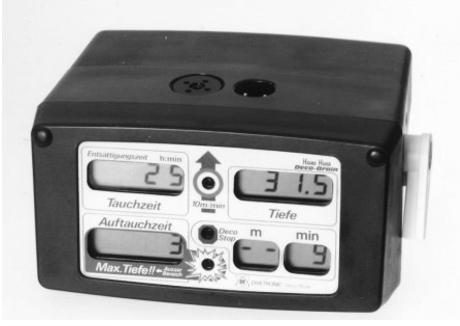
DIivetronic Deco Brain Hans Hass II
Encouraged by the success, the professor grew increasingly interested in this new path and became progressively more involved with various dive computer manufacturers, collaborating on the implementation of his algorithm and developing increasingly reliable decompression models. In November 1990, after forty-two years of distinguished service, Albert Bühlmann left the University Hospital. He passed away in March 1994, leaving behind his algorithm and the decompression tables that were the result of immense work, tables through which, with his concepts, he reshaped and improved the safety of modern commercial and recreational diving beyond imagination.
Meanwhile, Keller, with his inventive spirit and the generous severance from Shell, moved on to other fields. Although he continued working on the development of new hyperbaric chambers for navies and hospitals, he also designed drysuits that were form-fitting rather than bulky, along with innovative full-body suits for skiing and cycling. Keller also took an interest in computing, launching his own line of personal computers at a time when only a small community recognized the true potential of the sector. He developed his own programming language, "HK", an automatic spell checker, and some of the first word processing and translation programs.
He also cultivated interests in art, music, and literature, being himself a highly talented pianist. In the 1990s, the diver from Winterthur even ventured, albeit with little success, into politics. Finally, in 1999, he founded Visipix, a "global center of visual inspiration" on the web.
Hannes Keller reached the end of his life, rich in adventure and action, in December 2022.
________