FIRST PART
December 1962 – Swiss mathematician Hannes Keller reached the astonishing depth of 305 meters off the coast of Catalina Island, California. Although he stayed outside the diving bell for only a very short time and tragically lost his buddy during the ascent, this inspired amateur from a landlocked country had proven that the frontier of human exploration in the sixth continent was even vaster than previously imagined.
Hannes Keller began diving in the mountain lakes of his homeland in the late 1950s. To do so, he built his own regulator, and dive after dive, he soon realized that, much like space exploration, venturing into the deep sea was a field where research could have a powerful global media impact.

The young Keller with his self-built regulator
To satisfy his urge to go beyond, Keller came to the conclusion that the best way to begin was to break the world depth record. But unwilling to settle for half measures, he immediately set himself the goal of reaching the unthinkable depth of 300 meters - at least four times deeper than any oil company was drilling at the time. However, being no fool, he realized that to pursue this path he needed someone who could support him from a medical and physiological standpoint. For obvious reasons, his choice fell on Dr. Albert Bühlmann, who at the time was head of the cardiopulmonary laboratory in the Department of Medicine at the University Hospital of Zurich. It's worth noting that Keller's primary expertise at the time was in mathematics, while Bühlmann's was in lung-related diseases and aviation medicine. Neither of them had any real knowledge of diving. Nonetheless, both were aware that to reach such depths it would be essential to breathe a mixture of helium and oxygen, and that just five minutes spent at that depth would require at least four and a half hours of decompression. A study by the U.S. Navy had shown that for short dives at moderate depths, decompression needed to be longer when breathing a helium-based mixture than when breathing regular air. Keller and Bühlmann deduced from this that the body, and certain tissues in particular, became saturated more quickly with helium than with nitrogen.
A hypothesis that they themselves later confirmed through numerous laboratory experiments, establishing that the saturation rate of helium in all tissues is 2.65 times faster than that of nitrogen. Therefore, if a mixture of only helium and oxygen were used, the decompression required for a very deep but very short dive would be completely disproportionate to the time spent at the bottom. Nevertheless, despite their many gaps in knowledge about how to approach underwater diving, Keller’s strong mathematical skills and Bühlmann’s deep understanding of physiology allowed them to develop their own personal system. The idea was to compress the divers as quickly as possible inside a diving bell using a series of gas mixtures with high concentrations of oxygen and a fixed amount of nitrogen, and to switch to a helium-oxygen mixture only near the bottom.
Then, during decompression, nitrogen would be reintroduced at the greatest possible depth, followed by a complete replacement of helium with nitrogen to speed up the elimination of helium from the tissues. All of this was done through a continuous ascent, without the usual staged stops. This combination of inert gas switching during the dive and breathing high partial pressures of oxygen - never less than 2 atmospheres - to shorten decompression times, was kept secret for a long time and remained the subject of much speculation for years. The same applies to the innovative method Keller and Bühlmann devised for calculating decompression, with which they developed approximately 400 decompression tables for depths up to 400 meters. They did this using a computer at the IBM center in Zurich. After much analysis, in November 1959, under Bühlmann’s supervision, Keller descended to a depth of 122 meters in Lake Zurich inside an upside-down 50-gallon drum weighted with stones. His equipment was borrowed, and for emergencies, he had a rapid ascent device made from an old inner tube from a car tire. Later, Keller himself would candidly admit that the experience had been quite terrifying, driven more by madness than by reason.


Hannes Keller in the Toulon chamber during a test before a dive
The following year, in 1960, the Keller-Bühlmann duo did not give up but, mindful of their past experience, realized they needed to proceed with less approximate methods. This new approach was facilitated by the French Navy, which, thanks in no small part to encouragement from Cousteau, made the hyperbaric chambers of the Groupe d'Études et Recherches Sous-Marines (GERS) in Toulon available to them. Seizing the opportunity, a first dive to 250 meters was conducted in November of that same year, followed by two more in April 1961, one to 300 meters and another to 250 meters.

Tolone - Profilo dell'immersione in camera a 250 m
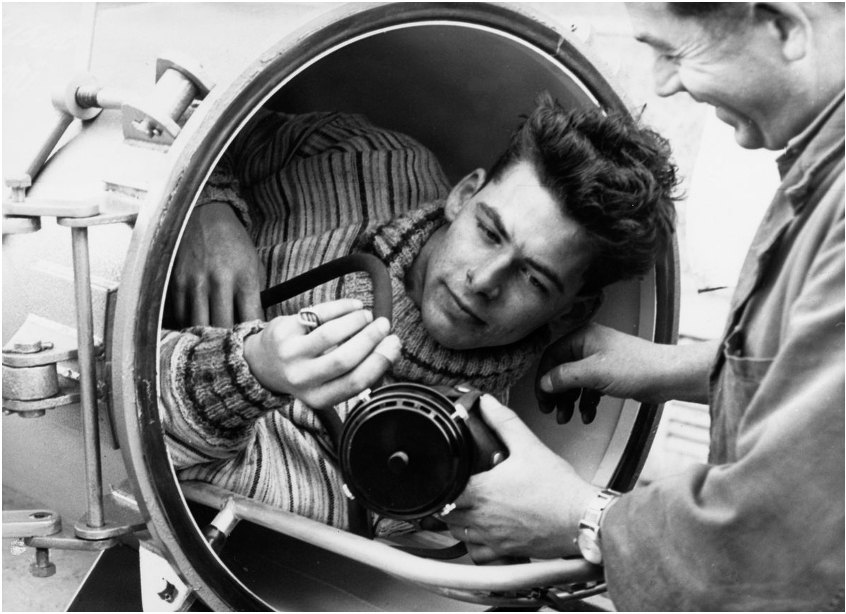
Hannes Keller in the Toulon chamber during a test before a dive
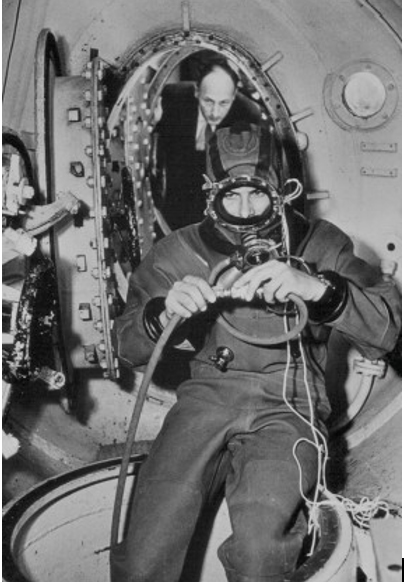
Hannes Keller (in front) and Professor Bühlmann in Toulon
before a chamber dive at 250 m
A very peculiar episode, which occurred during the compression phase of a 300 m dive, and which today makes us smile a little, took place when Keller was brought from 91 m to bottom pressure in just two minutes (a compression rate of over 100 m/min), experiencing mild tremors and dizziness. On that occasion, everyone realized that he had definitely shown some mild symptoms of HPNS (High-Pressure Nervous Syndrome).
And although little was known about the subject at the time, what neither Keller, Bühlmann, nor anyone else knew was that nitrogen, which was thought to serve solely to shorten decompression time, also helped counteract HPNS. In any case, after successfully completing the series of dives at GERS, it didn’t take long for the news to spread everywhere, both within the scientific community and beyond. A "phenomenon" that had emerged from nowhere was making dives at great depths, breathing who knows what strange and mysterious gas mixtures. But most of all, he was resurfacing without any issues and with decompression times that seemed absurdly and ridiculously short. The scientific and professional diving community, with no real understanding of what was happening, immediately began taking sides in the debate over how the Keller-Bühlmann duo was managing to outwit them. So much so that Dr. Henry Hempleman, then head of the Royal Naval Physiological Laboratory (RNPL), stated: "Keller and Bühlmann are making all of us - the U.S. Navy, Royal Navy, and GERS - look like a bunch of cave-dwelling divers with no real understanding of diving physiology that could lead to safe and short decompression procedures." The controversy within the academic diving world became heated, especially in the United States, where Captain George Bond, later considered the father of saturation diving, was convinced that Keller and Bühlmann had developed a new diving technique, and that this knowledge had to be absolutely acquired by the U.S. Navy. Conversely, Captain Robert Workman was equally convinced that there was nothing to be learned. In the end, as always happens, a compromise was reached. Since Keller and Bühlmann had only carried out very deep dives lasting just a few seconds at bottom depth, the U.S. Navy would offer a contract for a demonstration dive to 213 meters, with a stay of at least ten minutes at the maximum depth. Even though everything seemed settled, with a date and location in Washington already decided, further controversy soon erupted.
Completely distrusting the U.S. Navy, who had indeed granted a contract to demonstrate the theory, but above all to uncover the secrets of the diving method, Keller and Bühlmann demanded full control of the NEDU hyperbaric simulation chamber. At that point, neither party could back out of the agreement. After yet another compromise was reached, on May 10, 1961, under the supervision of Dr. Bühlmann, Keller completed the planned dive in the astonishing time of around 100 minutes. Everyone was stunned, but no one more so than Dr. Hempleman, who, after witnessing the dive, followed Keller for several hours, expecting to observe some side effects. But nothing, Keller remained completely asymptomatic in every respect, not even experiencing a slight headache. Years later, recalling the 1961 dive, Dr. Hempleman admitted that it had not only been a victory for the Keller-Bühlmann approach to the problem, but much, much more. Indeed, that achievement sparked a significant increase in interest in deep diving research, both in the United States and in Europe, as the knowledge gained would prove extremely useful for the exploitation of offshore resources around the world.
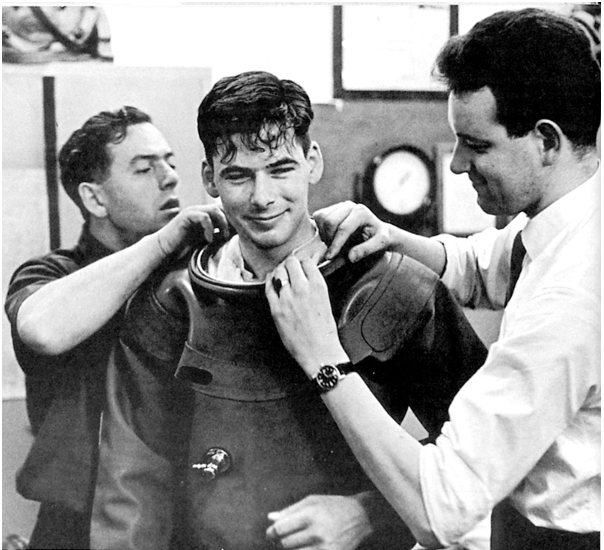
Keller preparing at the U.S. Navy Experimental Diving Unit
However, even though everything had gone according to plan, the level of distrust was such that the general reaction, and especially that of the U.S. Navy, was that Keller's successful dive had been a fluke, and that the proposed system wouldn’t work with anyone else. Disheartened by the many doubts still being raised about their approach to diving, Keller and Bühlmann realised that the only way to prove the method’s effectiveness was to convince the U.S. Navy to grant them another research contract to carry out a deep dive with a partner. Once they received the green light for the endeavour, Keller began searching for a diving buddy. After careful consideration, including commercial factors, the choice fell on a senior editor at Life magazine, a certain Kenneth MacLeish.
Keller offered him a $2,000 round-trip ticket for a dive to a depth of 213 meters in Lake Maggiore. In this way, Life would get a unique and remarkable story, while Keller and Bühlmann would demonstrate to the U.S. Navy and all their critics that an ordinary person could safely perform such a dive. Intrigued by the unusual offer, Keller’s future dive partner immediately asked for clarification and reassurance about the risks involved. Without hesitation, Keller replied, “Very, very risky!”, adding that he himself was extremely frightened by it. That brutally honest admission was exactly what convinced MacLeish to buy the ticket.
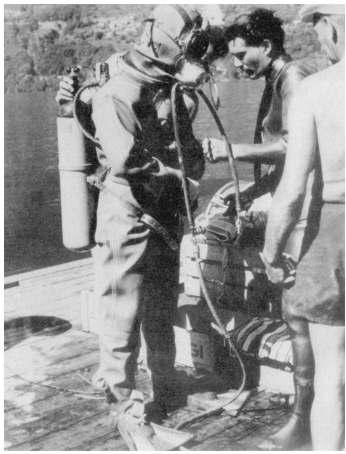
Keller in a constant-volume dry suit, with Kenneth MacLeish on Lake Maggiore
From the very start of this latest adventure, both Keller and Bühlmann, becoming increasingly convinced that others were trying to uncover the secret of their gas mixtures by any means necessary, were pushed to a wild idea: in order to protect their secret, Keller considered diving with a homemade closed-circuit rebreather. It was only by chance - an unexpected visit by Hempleman to Keller’s workshop in Winterthur - that he was persuaded to donate free samples of his gas mixtures. On that occasion, seeing that Keller was unaware of the difficulties a closed-circuit system entailed, Hempleman advised him to use the more reliable open-circuit system for the dive. Finally, after extensive preparations, on June 28, 1961, on Lake Maggiore off the coast of Locarno, Switzerland, with Lieutenant Commander Charles Aquadro present as the official U.S. Navy observer, everything was ready. There was no diving bell available, only a raft from which the two divers would be lowered using a platform specially built by Keller and his assistants for the dive. As advised by Hempleman, the gas was breathed through an open-circuit system, using a hose connected to a set of cylinders placed on the raft, with a regulator at the other end. With Bühlmann in charge of the operations, Keller and MacLeish descended to a depth of 222 meters and resurfaced in one hour. The dive had been preceded by one hour of breathing pure oxygen at the surface to eliminate all nitrogen from their tissues. During the dive, there were four gas switches on the way down and four on the way up, beginning and ending with pure oxygen. Both Keller and MacLeish, to protect themselves from the icy water, wore constant-volume dry suits from Spirotechnique. On their backs, they carried two tanks filled with a generic “rescue mix” to be used in the unfortunate event of an emergency ascent. Faced with such a successful outcome - especially considering that the Royal Navy, during a previous dive, had taken nearly twelve hours to decompress a diver after five minutes at 185 meters (including time for treating mild decompression sickness) - even the most sceptical voices were definitively silenced. And all the more so, considering that MacLeish, an ordinary editor, had received only three days of training before taking this leap into the unknown. Having convinced the doubters that the deep diving approach was indeed feasible and applicable even to the average person, Keller and Bühlmann were persuaded by the increasingly interested U.S. Navy to sign a new research contract for a series of deep dives at 152, 198, 250, and 305 meters. With Bühlmann always in charge of the physiological aspects, the dives began in 1962 at the simulator of Zurich University Hospital, inside a two-person hyperbaric chamber designed by Keller himself and built by the Swiss company Sulzer. In what would be the final dive of the series, Keller and his new test partner, Peter Small, co-founder of the British Sub-Aqua Club, reached a depth of 305 meters, where they remained for five minutes while breathing various gas mixtures through regulators. The entire dive required only 270 minutes of decompression, without any symptoms of decompression sickness or other complications.
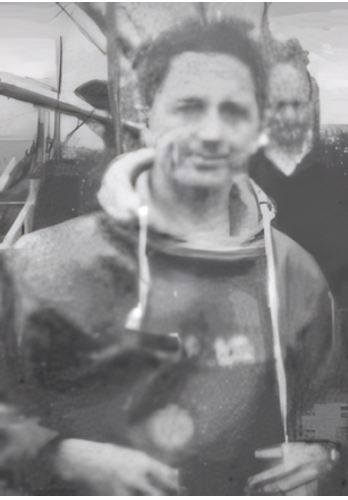
Peter Small

Gas mixtures breathed by Keller and Small during the 305-meter dive
Having successfully completed the first phase, Keller and Bühlmann, since the contract with the U.S. Navy stipulated that dives in the simulator were only a prelude to a real dive to be carried out in the Pacific, developed a specific action plan for this decisive test. This dive, of course, would be completely different from the simulations conducted in the comfortable hyperbaric environment of Zurich, and it was certainly not feasible to plan a descent and ascent exposed to water as in Lake Maggiore. Therefore, with financial support from the U.S. Navy and Shell Oil, which would provide the ship Eureka as a support base, the company Sulzer was commissioned to build a diving bell, the Atlantis.
END OF FIRST PART
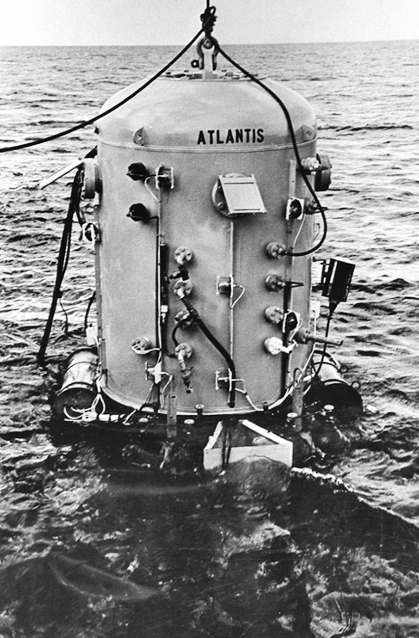
Atlantis off Catalina Island (ph. Paul Tzimoulis)
Fine prima parte
___________