
1 - Ideograms for “Sea” and “Woman”, which together form “Ama”,
meaning “Women of the Sea”
In July 1954, Fosco Maraini, writer, Orientalist, and photographer, travelled with a small film crew to Hèkura Island, a tiny landmass located north of Japan, to meet an isolated and independent community living in symbiosis with the sea. They were the Ama, the sons and daughters of the waves. Within their rigid social organisation, women were entrusted with a crucial task: diving in breath-hold along the seabed off the island to harvest Awabikoshi (abalone), a single-shelled mollusc belonging to the Haliotidae family, highly prized for its delicacy.
Today, that unique tradition and that unexplored community portrayed by Maraini with the precision of a scholar and the flair of a storyteller in his book The Island of the Fisherwomen have virtually disappeared, eroded by an insidious and, in many respects, unstoppable modernity.
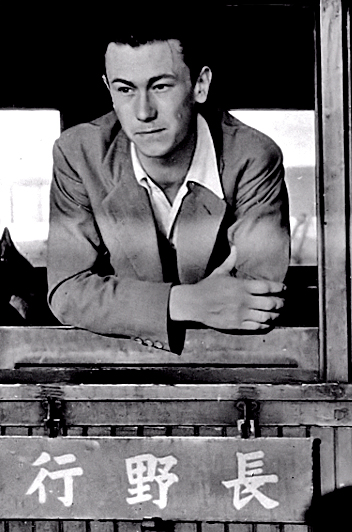
2 - Fosco Maraini
From that journey through and beyond time, which introduced this mysterious world to the wider public, the encounter with these sirens of the ocean emerges once again: resilient women bound to the sea by an ancient and unique relationship. Tradition holds that for centuries, along the coasts of Japan’s numerous islands, legendary figures known as Ama, “people of the sea”, or those who live by the coast, have dwelt. More precisely, however, the term Ama has many local variations, as Ama cultures existed from northern Honshū to the southern Ryūkyū Islands. An example is the Kaito culture in the Izu Peninsula, in Shizuoka Prefecture.
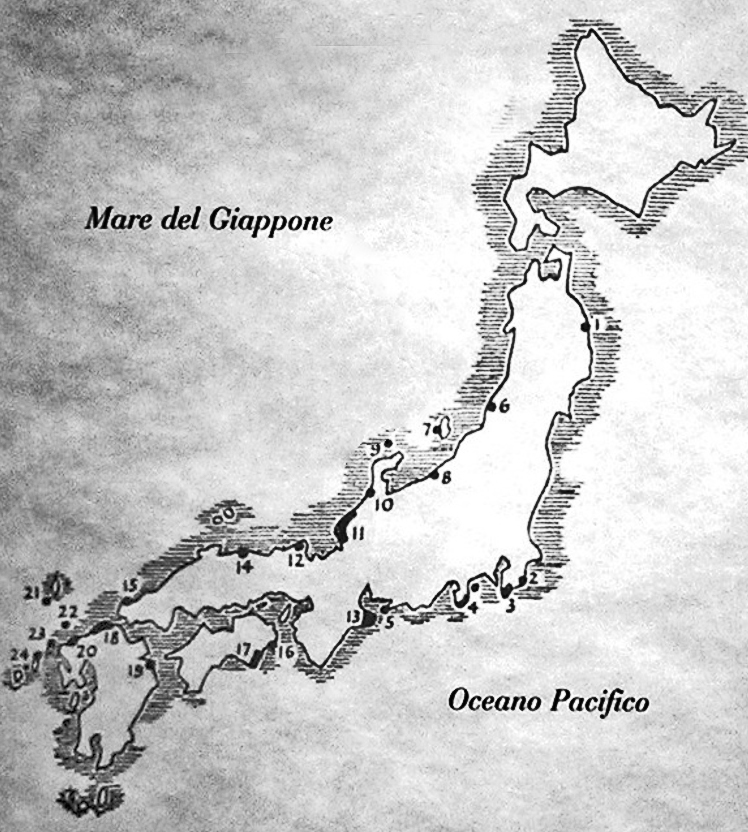
3 - The 24 villages inhabited by the Ama in the early 1950s
Contrary to Western assumptions, the term Ama does not refer exclusively to women but also to men, with different graphic representations depending on gender. Female Ama: literally “women of the sea”, written using the kanji for “woman”. Male Ama: literally “warrior of the sea”, represented with the kanji for “gentleman of the sea”, or Samurai. Although less well known, men were also engaged in fishing in ancient times. Over time, however, the profession became predominantly female, as women proved better protected against the cold waters of the ocean thanks to their characteristic layers of body fat.
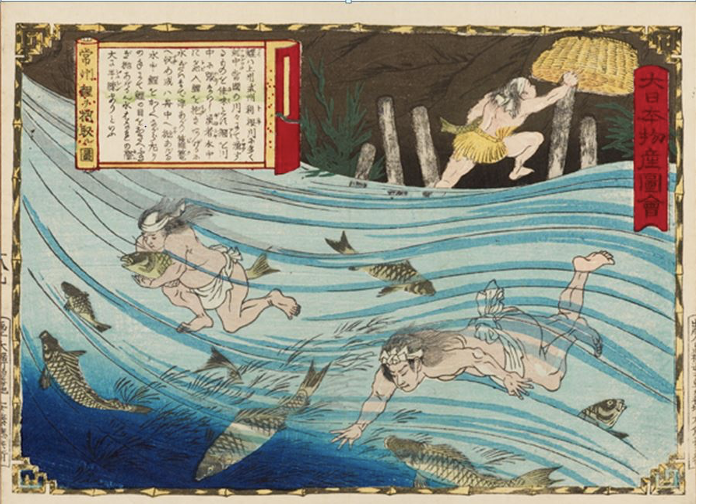
4 - Male Ama hunting carp – Hiroshige, 1877
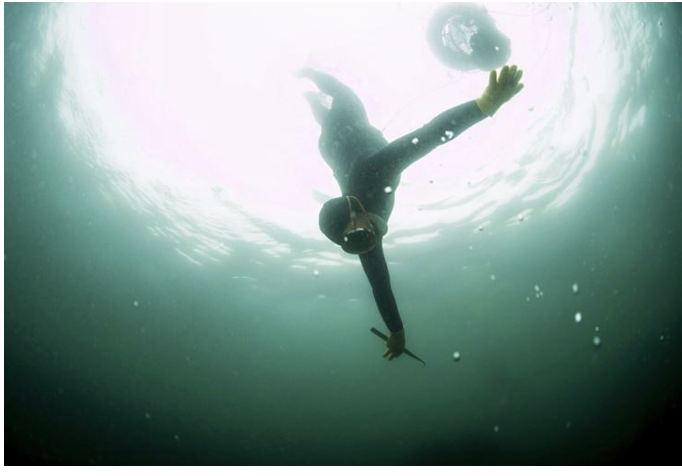
5 - Modern male Ama
As regards the historical origins, the earliest Ama communities date back to the Late Jōmon Period (2000 - 300 BC) and the Yayoi Period (300 BC - AD 300), as evidenced by tools used for collecting abalone discovered on the Shima Peninsula. The term Ama first appears in the Man’yōshū (Collection of Ten Thousand Leaves), an anthology of nearly 5,000 waka poems composed in the eighth century. Another detailed reference is found in the Engishiki (AD 927), a compendium of laws and customs. It mentions Ama in the city of Shima, called Kazukime (“fishing women”), who paid taxes in the form of awabi (abalone).
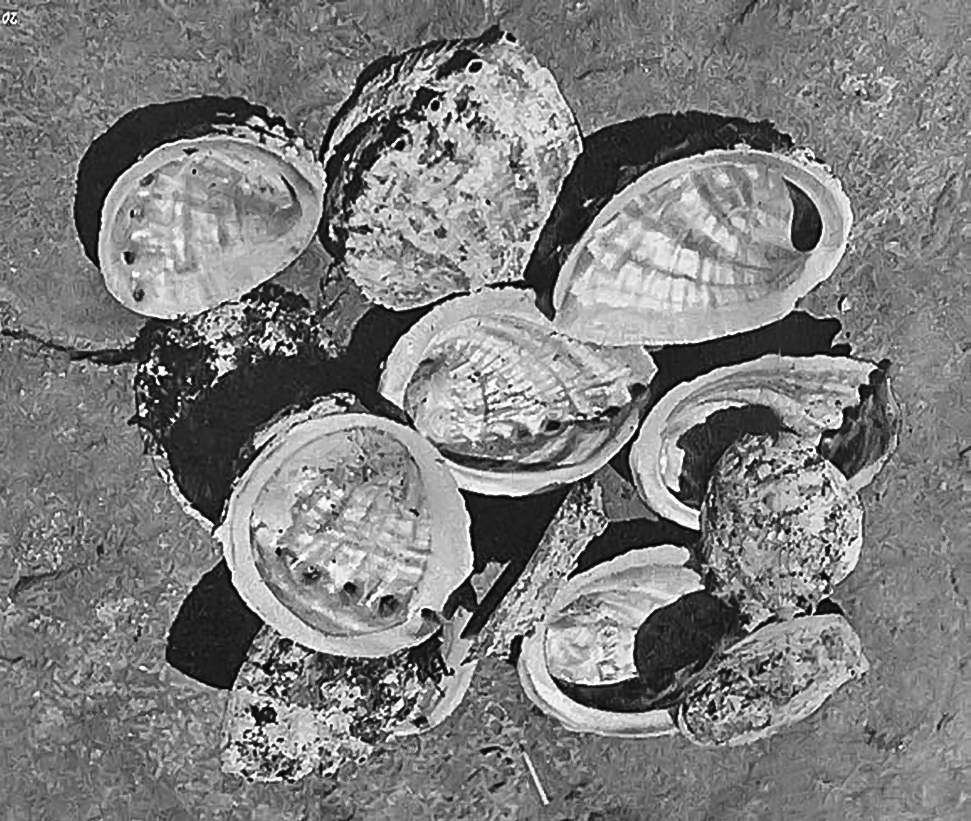
6 - Awabi (Abalone)
Countless other sources in which the Ama appear in all their grace are the many Ukiyo-e prints dedicated to them, true glimpses of real life portraying these noblewomen of the sea in all their beauty. A particularly fascinating feature of the Ama world lies in the fact that their rhythm of life, long regulated by tradition and largely unchanged, underwent a transformation between the nineteenth and twentieth centuries, during the Meiji era, due to the scarcity of work brought about by the end of Japan’s isolation. This gave rise to the need to migrate to other destinations. Initially, these movements were directed mainly within Japan (to the Kii Peninsula, Tosa, Hokkaidō, Kyūshū, Izu, and elsewhere). However, following the opening of the borders in 1876, they began to head predominantly towards the Korean Peninsula, specifically to Jeju, Ulsan, Busan, Geojedo, and Dokdo, giving rise to the Korean women divers known as the Haenyeo, and, to a lesser extent, across the Pacific to the coasts of the United States.
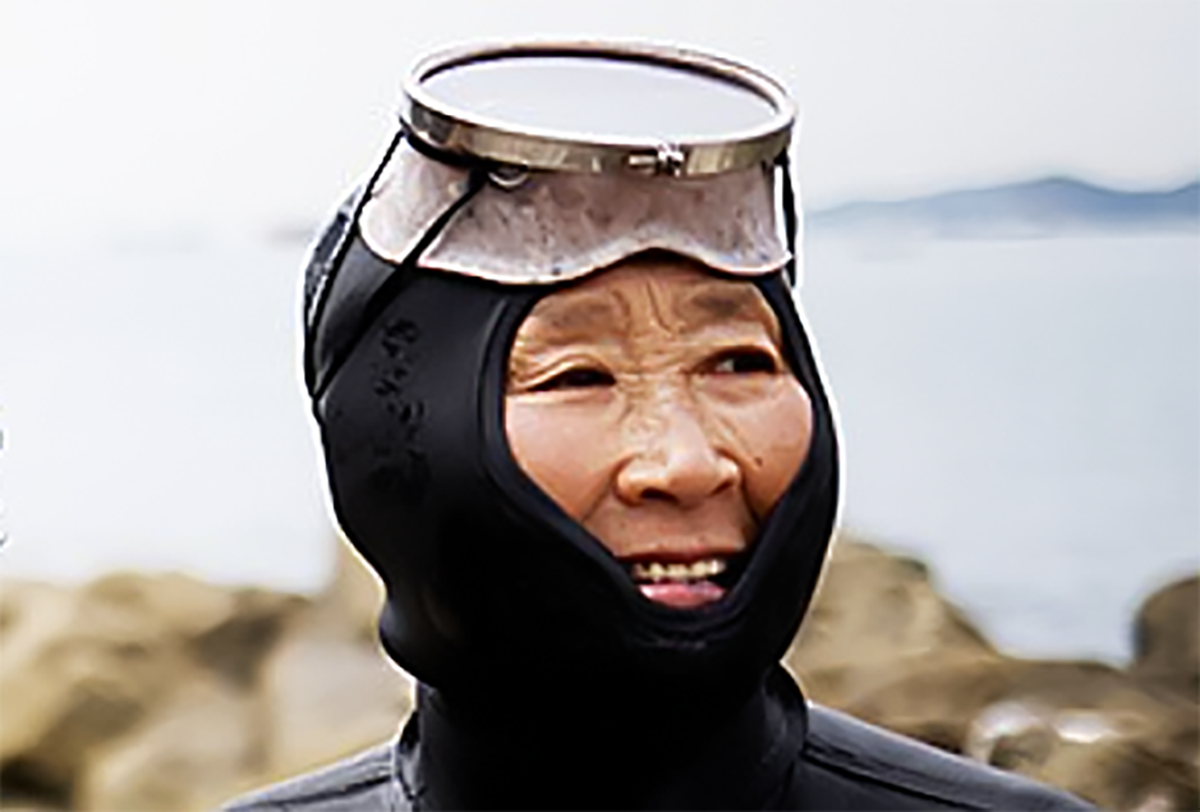
7 - Korean Haenyeo Diver
Today, the graceful and sinuous Ama-san, also known as Uminchu in the Okinawan language or as Kaito on the Izu Peninsula, find refuge from modernity primarily in Mie Prefecture, on the island of Honshū, and in the cities of Shima and Toba, guardians and sole custodians of a millennia-old tradition.
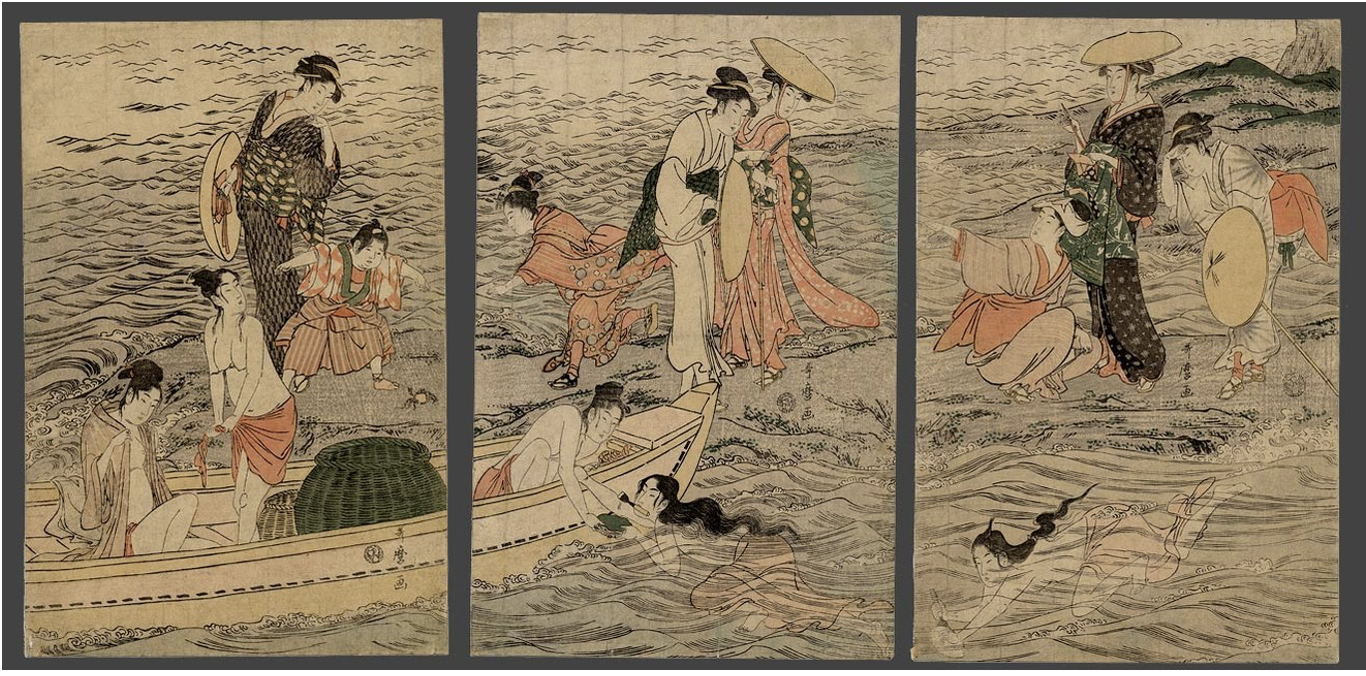
8 - Utamaro 1788–1790 Awabi Tori
Sirens who still explore the seabed in breath-hold, in search of those treasures that only the sea can offer. Out of curiosity, were one to type the term Ama into the web, the resulting images would portray these enchanting figures immortalised in the photographs of Fosco Maraini and Iwase Yoshiyuki, a Japanese documentarian devoted to preserving the fading traditions of Japan’s coastal regions and inspired by a profound passion for ‘the simple and even primitive beauty of the Ama world’.
The Ama met by Maraini in the most remote islands were dressed in traditional clothing consisting of a loincloth, the Fundoshi, or an Isonakane, a white cotton cloth resembling a simple costume, together with a headscarf known as the Tenugui, used to tie back the hair. This characteristic outfit of the Meiji era (1868–1912) underwent a significant transformation between the end of the Meiji period and the beginning of the Shōwa period (1912–1926), with the introduction of a cotton garment akin to a kimono, known as the Isoshatsu or Isogi. This provided greater protection against jellyfish stings and covered nudity, which had become increasingly unacceptable at the time. In addition to their traditional clothing, photographs reveal several tools that the Ama have used regularly for centuries. Among these are the Kaginomi, a long, curved knife employed to detach shellfish from the seabed, and the Isooke, a wooden bucket used primarily by the Kachido. It serves both as a float to support them between dives and as a container for storing the products they collect.
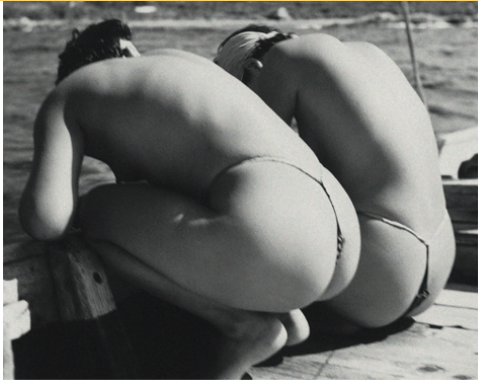
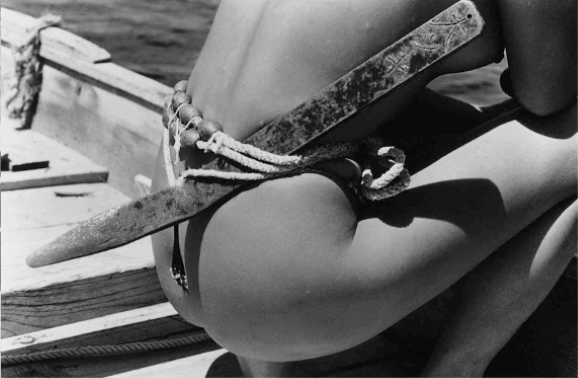
9 - Fundoshi (loincloth 10 - Kaginomi (crowbar)
(ph. Fosco Maraini)
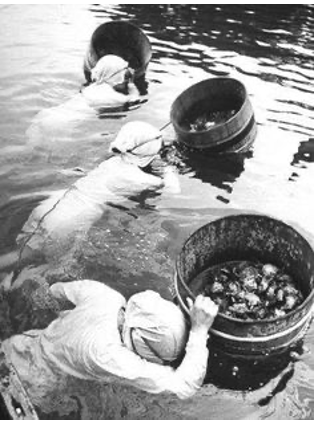
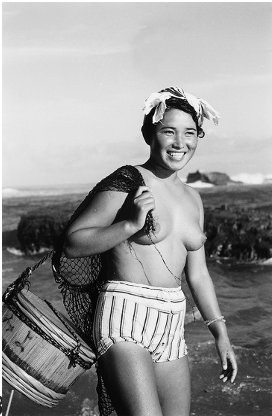
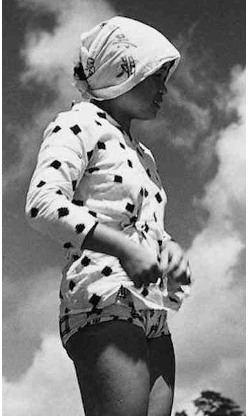
11 - Isooke (bucket)12 - Isonakane (costume)13 - Isogi (dress)
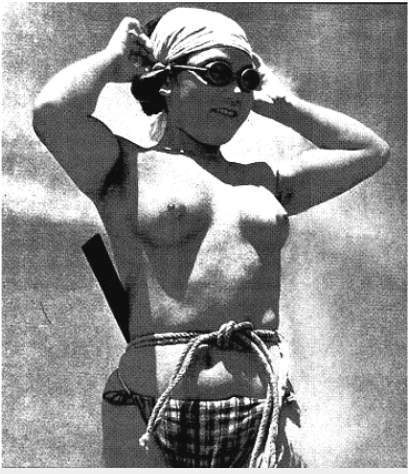
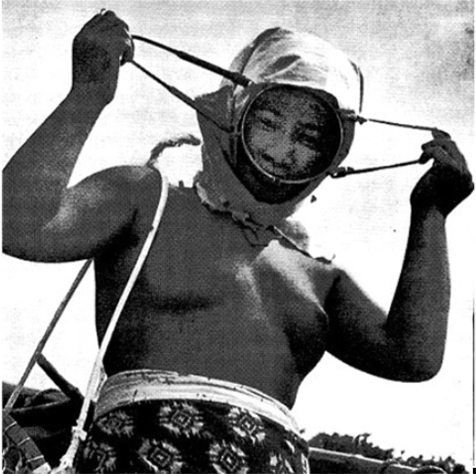
As mentioned previously, the world of the Ama has always been strictly tied to tradition and has never been affected by major changes. Since their origins, the Ama have practiced fishing by taking whatever the sea offers, almost blindly, literally mekurasagashi, “searching blindly.” Then, at the beginning of the 20th century, in this world so resistant to change, the small goggles known as Isomegane made their appearance.

14 - From right to left: the evolution from uncovered eyes to modern masks.

15 - From left to right: the evolution from uncovered eyes to modern masks.
Over the following decades, these evolved with the adoption of pressure-compensation bulbs, followed by the arrival of the single-lens monogoggle mask, and finally the development of masks that also cover the nose.
 |
 |
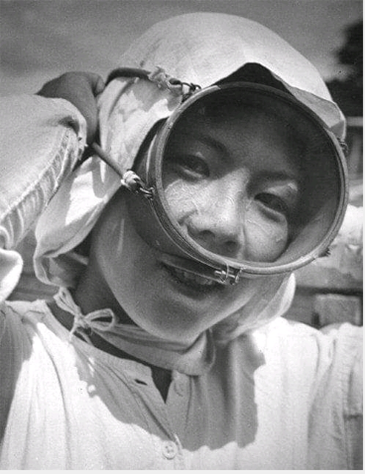 |
16-17-18 - Isomegane, meaning small goggles or the mask
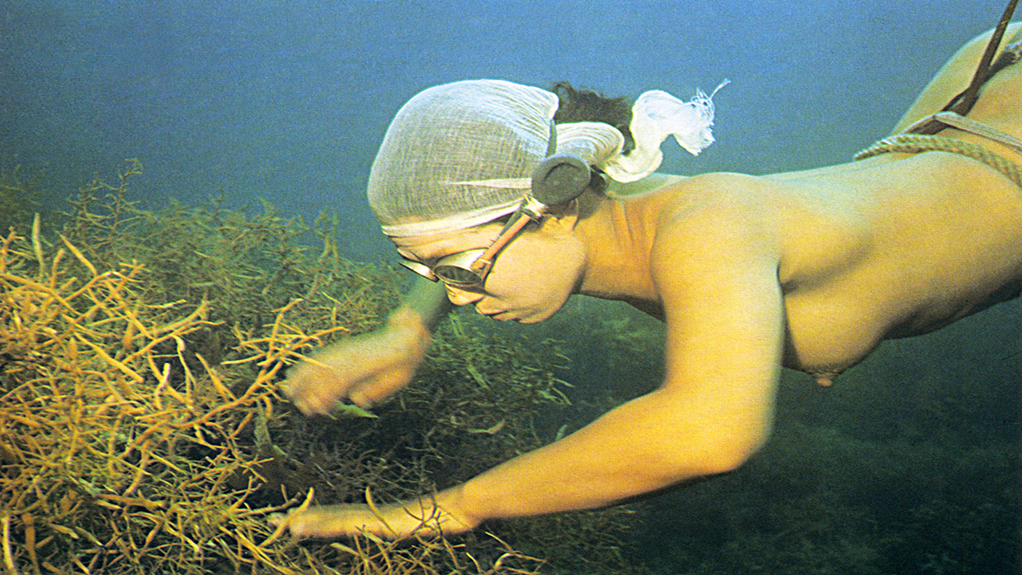
19 - goggles with pressure-compensation bulbs
(ph. Fosco Maraini)
In the early 1960s, another small revolution driven by modernity took place. The first fins began to appear, while the traditional garment, the isoshatsu or isogi, was gradually replaced by warmer, more modern neoprene wetsuits, called uetsutosūtsu. Alongside these changes, a system was also introduced to counteract the significant positive buoyancy generated by the wetsuit. It consisted of a belt with a substantial lead weight, the hachikonawa. This replaced the traditional cord tied around the waist with small tubular fishing-net sinkers attached, more than sufficient when diving while naked or wearing only a simple garment.
Another extremely interesting chapter, still closely linked to tradition, is the training of young women who wish to enter the Ama profession. They are introduced to diving from as early as ten or eleven years of age, competing with one another in a game-like activity of who can collect the most stones from the seabed. Later, usually between the ages of sixteen and twenty-two, formal training begins, a period in which the future “mermaids” learn diving techniques by following ancient rituals passed down from generation to generation. Once training is completed, the young women are divided according to the type of work they will perform, acquiring the status of oyogido or kachido. They do not have access to a boat but instead depart from the shore and dive to shallower depths, generally around four meters, using the isooke as support to rest and to store the harvested marine products. This status also includes not only the younger and less experienced divers, but also older women who, due to age, have less endurance for deep and prolonged dives. Unmarried girls are also part of this group, since tradition does not allow them to go out on boats alone with a man. Alternatively, more organized unmarried women go out in groups of two or three on a boat operated by a female boat operator.
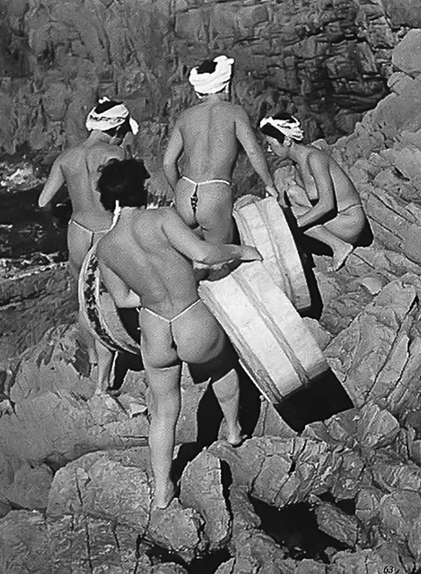
20 - The oyogido or kadhido dive from |
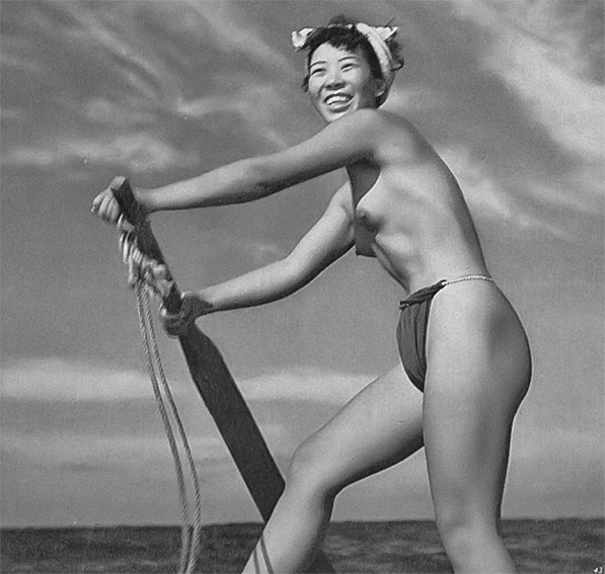
21 - Ama rowing on a women-only boat |
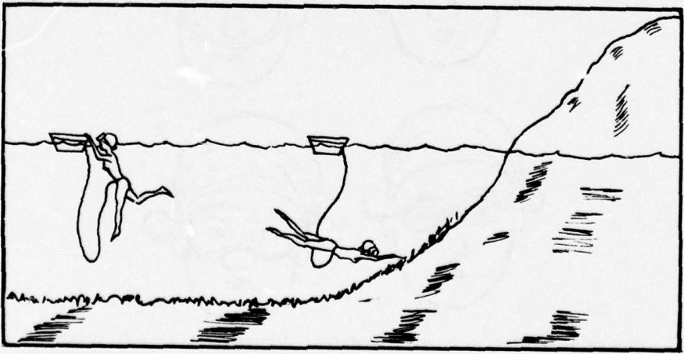
22 - Oyogido or Kachido in action
In addition to the status of oyogido or kachido, an Ama diver can attain the rank of funado or funedo. This position brings together all those veteran divers who dive to greater depths from a boat, the fune, meaning “boat.” They always operate in pairs with a man (usually their husband), who remains on the boat as an assistant. These are the most skilled Ama, as they dive to depths sometimes exceeding thirty meters, using 10–15 kg stone weights during their descent, which they then leave on the seabed. The diver has a rope tied around her waist, with the other end held by the man on the boat. When she reaches her breath-hold limit, she gives a tug, this is the signal for her to be quickly pulled back to the surface.
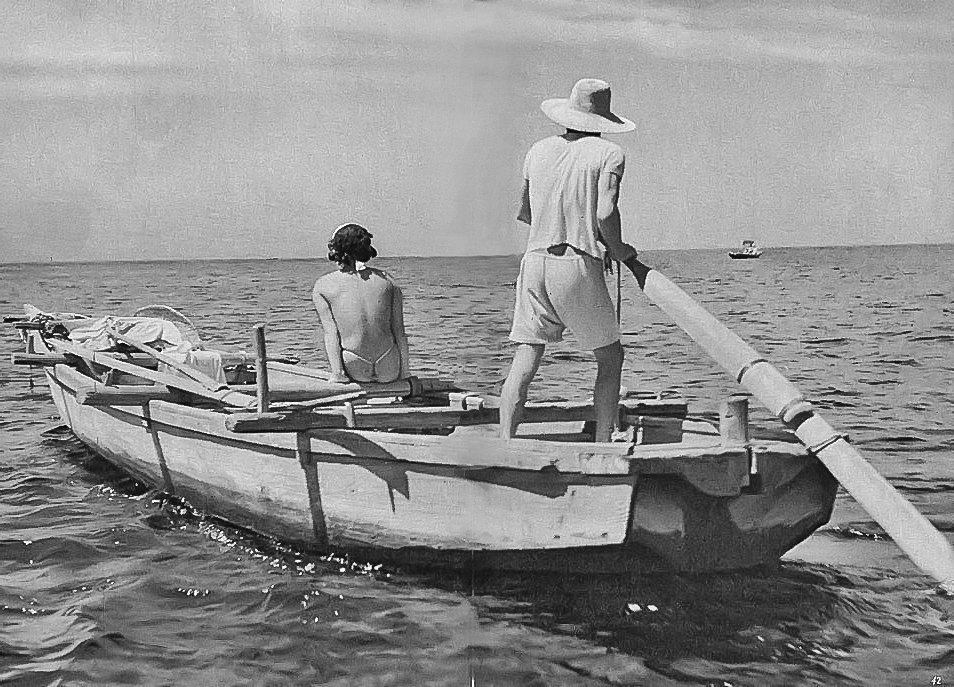
23 - Ama Oyogido or Kachido
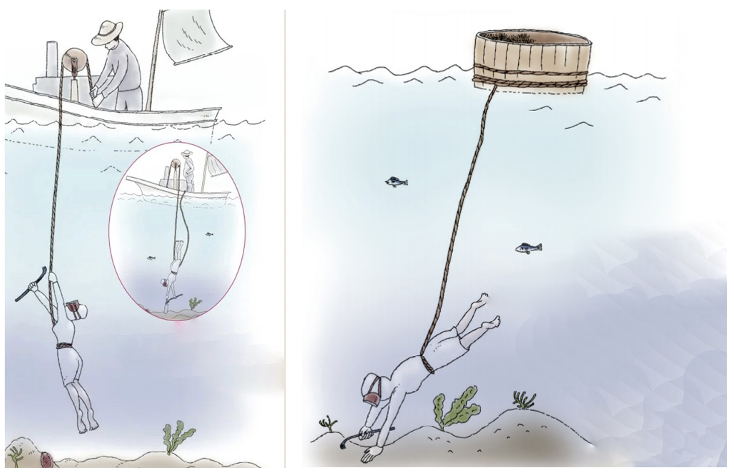
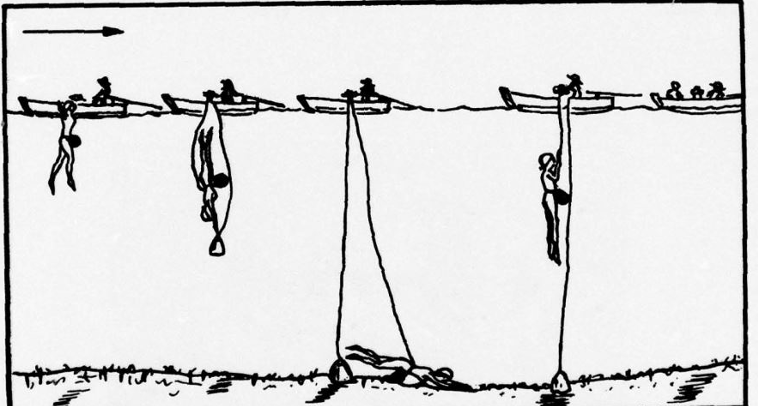
24-25-26 - The different diving techniques of the Ama
Centuries upon centuries of tradition and experience have made the freediving skills of these “mermaids” legendary. Over time, they have refined techniques that allow them to remain underwater for more than two minutes, during daily boat outings lasting over four hours, following the rhythm that will be described below. Before diving, the Ama perform deep and rapid breaths for five to ten seconds to properly oxygenate the lungs (hyperventilation), then take a final breath without ever fully filling their lungs and head off into the depths. When they resurface, they emit a characteristic sound, the Ama isobue or “the call of the mermaids,” but it is actually just a kind of whistle produced by a forceful exhalation immediately followed by an inhalation, as they resume normal breathing.
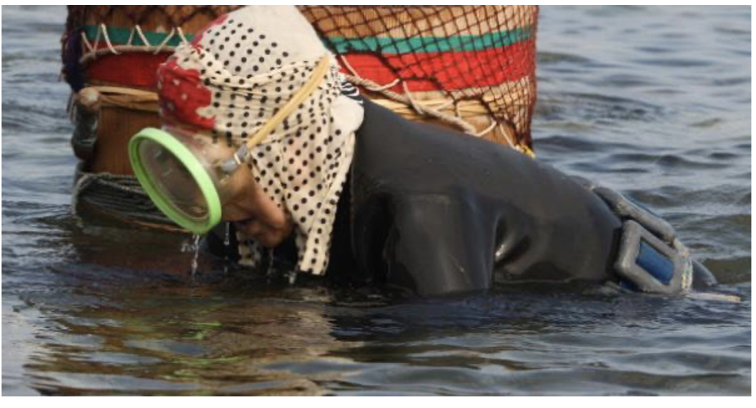
27 - Ama exhaling and then forcefully inhaling immediately upon resurfacing,
producing a distinctive sound known as isobue or “the call of the mermaids.”
This sound, over the centuries, has helped fuel the mythical image of enchanting siren songs that lure men. For the Japanese, however, this “song” represents the hard labour of the Ama, so much so that it has been included among the first 100 characteristic sounds of Japan. As for traditional diving techniques, it should be noted that they have not undergone major changes since their origins. In shallow waters, usually between four and six meters, the Ama remain submerged for about 30 seconds, of which only around 15 seconds are spent collecting. In deeper dives, even beyond thirty meters, they remain on the seabed for over a minute, with approximately thirty to forty seconds dedicated to gathering. While the dive itself varies depending on the Ama’s status, the rhythm appears to remain constant for each session, divided into shifts that can last from one to one and a half hours: in a typical one-hour shift, for example, about fifteen minutes in total are spent on the seabed, fifteen minutes are used for descents, and thirty minutes are dedicated to resting at the surface. A single session can include up to sixty dives.
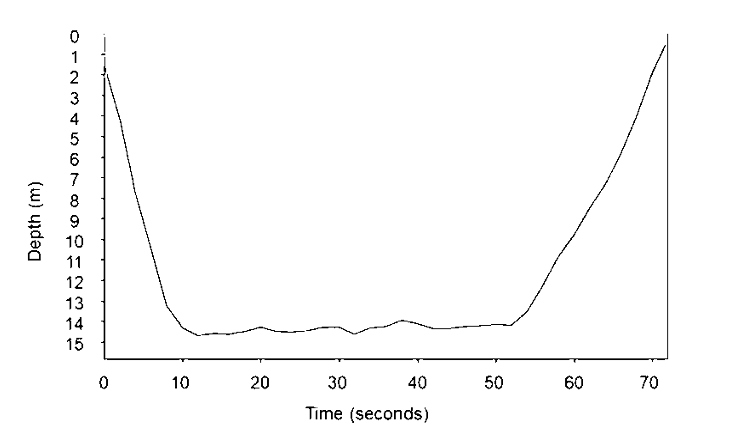
28 - Typical dive profile of a funedo
The Ama are distinguished not only by their diving skills, but also by the sense of female solidarity and community through which they carry out their ancient daily rituals. This, in addition to helping them share experiences and diving sites, becomes a symbol of a certain social independence that allows them to choose their own living conditions, a significant factor in rigid Japanese society. Although many women tend to prefer remaining unmarried in order to preserve their independence, motherhood has never been a real problem; in fact, when they are pregnant, young Ama continue diving right up until the day of childbirth, resuming work shortly afterward. As for life out of the water, it revolves around the amagoya, wooden huts built beyond the reach of the tides, where the Ama gather in the morning to prepare for the hard day’s work and, once finished, take shelter to warm themselves by the fire after hours spent in the cold ocean waters.
Moreover, as this is a dangerous profession, they never forget to pray to the gods for protection. The worship of the Ise Shrine is deeply connected with the Ama of Shima and Toba. According to an ancient legend, Yamatohime-no-Mikoto, the founder of the shrine, after establishing the temple dedicated to the goddess Amaterasu, the most important Shinto deity, travelled to Shima, where an Ama named Oben let him taste an abalone. Enchanted by its flavour, he asked the woman to offer this seafood to the Ise Shrine. Thus, a tradition was born that continues to this day. Sea worship is equally important for this community; in fact, the Ama rely on two symbols to protect themselves from the dangers that may lurk in the depths of the ocean. The first symbol, called seiman, consists of a star drawn in a single continuous line. The second, called dooman, is a lattice made up of five vertical and four horizontal lines.
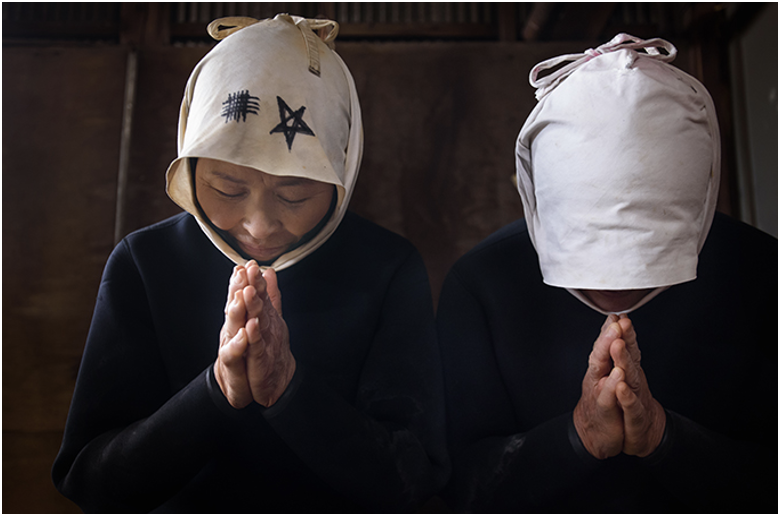
29 - Embroidered scarf (left) with the two symbols Seiman and Dooman.
These symbols are drawn on tools and sewn onto garments to keep evil demons away. There are also many local Shinto rituals, such as the Shirongo Matsuri in Toba, on Sugashima Island, during which abalones are offered to the Shinto shrine of Shirohige. An extremely important ritual for the Ama is the regular visit to various Shinto shrines to present offerings and attract the attention of the gods by ringing a gong, so that the legend may come true according to which every woman, at least once in her life, will have one of her wishes fulfilled.
Unfortunately, today this microcosm is slowly disappearing and, in order to survive, it has largely turned into a tourist attraction, effectively losing the mystical aura that once surrounded it. The number of Ama has drastically declined over time. From the ten thousand divers that existed up to the period immediately following the Second World War, fewer than three hundred remain, according to a census conducted by a Japanese newspaper in 2000.To make matters worse, most of them are now over fifty years old, so even the memory of those women who practiced this ancient art is gradually fading. The world that Fosco Maraini and Iwase Yoshiyuki made us dream of through their photographs and books no longer exists.
The blame for this situation is mainly placed on certain bureaucratic regulations that greatly restrict the profession (for example, in the case of marriage to a man who does not hold a fishing license, Ama are no longer allowed to dive). However, the reality is far more painful: it is the loss of appeal of this ancient and demanding art among younger generations. This realization has recently led the Mie Prefecture to nominate the “Mermaids of the Sea” to UNESCO as a World Heritage Site, in an effort to preserve the tradition.
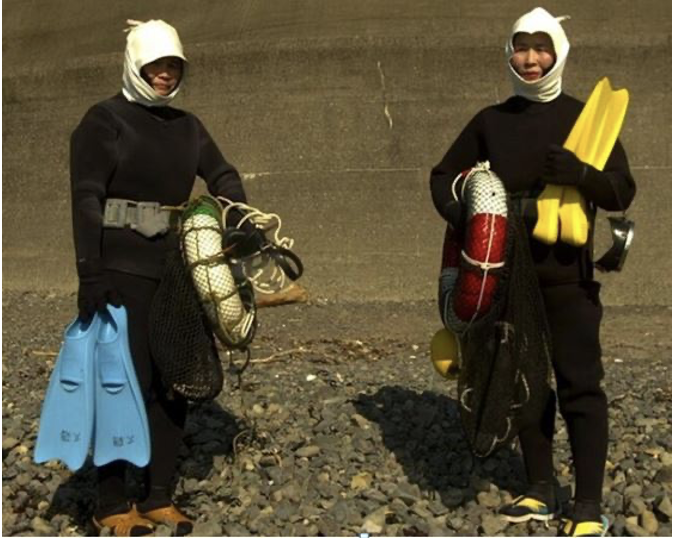
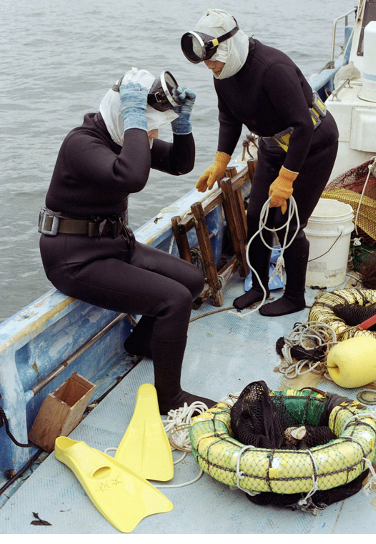
30-31 - Modern Ama Kachido and Funedo
SMALL AMA NOMENCLATURE
Ama: derives from the combination of the characters umi (sea) and onna (woman), or shi (man). Until the end of the Muromachi era (12th century), there was no word in the Japanese language for “fisherman”; the term ama was used for all those who lived off the sea.
Awabi: abalone
Kaginomi: crowbar or scraper for shellfish; an essential tool also called hera, kagi, or awabigane depending on the region.
Funado: Ama who dives from a boat
Hachikonawa: weight belt
Hakomegane: glass-bottom box used for viewing the seabed. Dating back to Japan in 1880, it is the precursor of the diving mask.
Isooke: large wooden bucket used both as a resting support and as a container for the collected catch, also called hanzo. Today it has been replaced by a more modern floating ring with a net attached for storing the harvest.
Fundoshi: loincloth, also called heko
Oshiroi: white makeup used as sun protection
Hire: fins; a recent, non-traditional term
Isogi: traditional Ama clothing used to protect against the cold and possible stings or abrasions, now often replaced by neoprene wetsuits
Kachido: Ama who dives from the shore
Koshimaki: in ancient times, long trailing cloths worn from the waist, believed to keep sharks away
Mayoke: talisman (usually a pentagram) sewn onto the Ama’s head covering to ward off demons
Isomegane: goggles or diving mask. Goggles were likely introduced to Japan by migrant workers returning from Hawaiian sugarcane plantations in the 1880s. Also called megane in some regions.
Sukari: collection net hung under the boat or floating bucket
Isonakane: white cotton cloth (a kind of costume)
Isobue: characteristic sound emitted by the Ama
___________